
Testing disaster response in Vienna: The PANTHEON pilot with Smart City Digital Twins
VIENNA, AUSTRIA – In the context of the EU Horizon 2020 PANTHEON project, a community-based digital ecosystem and Smart City Digital Twin (SCDT) is being developed.
The aim is to aid in increasing disaster resilience by improving decision-making efficiency and preparedness before, during and after disasters by tailoring tools for the right users. The platform enhances current disaster resilience models by developing evidence-based tools for analysis, training and evaluation. PANTHEON’S SCDT is built upon extensive analysis of community vulnerabilities with a special focus on hybrid threats and cyber-physical attacks.
The PANTHEON platform and technologies are integrating existing Internet of Things (IoT) infrastructure and multisource data through development happening in close cooperation with end-user organisations and field-tests like the pilot in Vienna in practical deployments. Benjamin Schuster and Tobias Schubert hosted the projects final TTX with a planning scenario and a small scale staff exercise for training.
The pilot itself brought together professional emergency services uniting to digitally simulate the two scenarios based on precise real-life data in the digital twins. One topic was the rising heat problem in urban environments. The second topic was a series of cyber physical attacks on backup power supply systems of Vienna’s communications infrastructure. During the PANTHEON platform’s pilot deployments planning and training scenarios were implemented to test and showcase the smart city digital twin’s abilities.
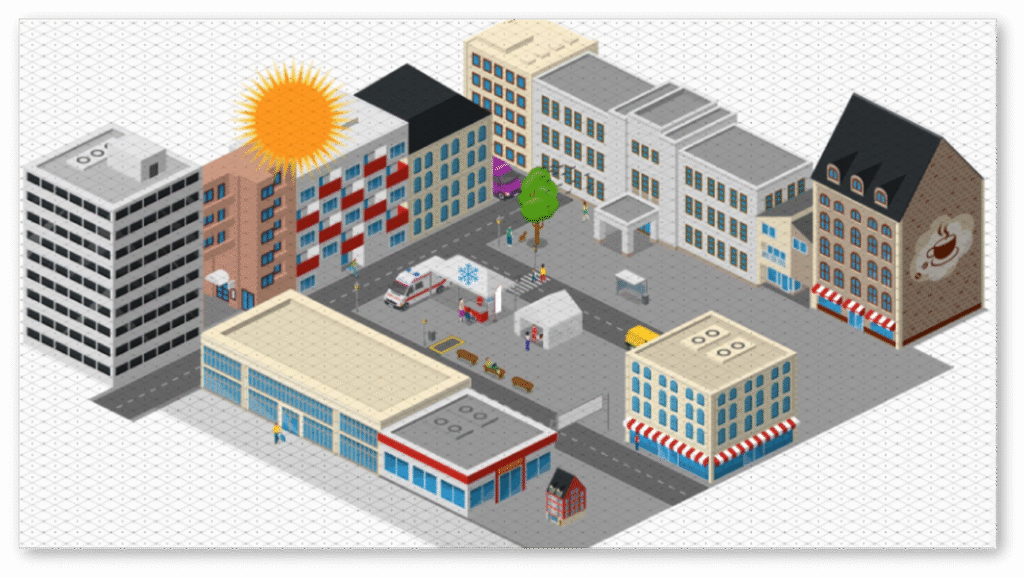
Use-Case 1 Heatwave
Vienna’s first round of guided tabletop exercise scenarios simulated a typical medical first responder planning task. It focused on the structured establishment of temporary outpatient care centres, referred to as ambulances, or in this scenario cooling spots for local relief and immediate care to people affected by a summer heatwave.
- The initial trigger: commissioning of Johanniter by the Viennese municipality to establish cooling spots in distinct parts of the city during an extensive heatwave.
- The first responder’s task Develop a plan to implement said cooling spots in an economical and practical fashion and coordinate the resource usage with the locally available personnel and material resources.
The first responders were presented a list of keypoints to consider during their own planning phase:
- Hotspot area (high temperature, no shadow, high solar radiation etc.; heat vulnerability defined as an area matching a set of parameters)
- Heatwave duration (use weather forecast and compare it to a period of time we already have data for)
- High population density / vulnerable groups (create focus areas with heightened need to have a cooling spot nearby)
- Available space (reachability)
- No cooling spot already present (exclude areas that already have spots initiated by the city)
- Prediction of probable deployment time/duration (derived from weather forecast compared to historic data)
The platform was explicitly presented as an additional tool and its usefulness in augmenting the planner’s everyday tasks was be evaluated. The evaluation results regarding the tool’s capabilities in planning tasks and as a decision support were highly regarded and open aspects and new feature requests incorporated for further development.
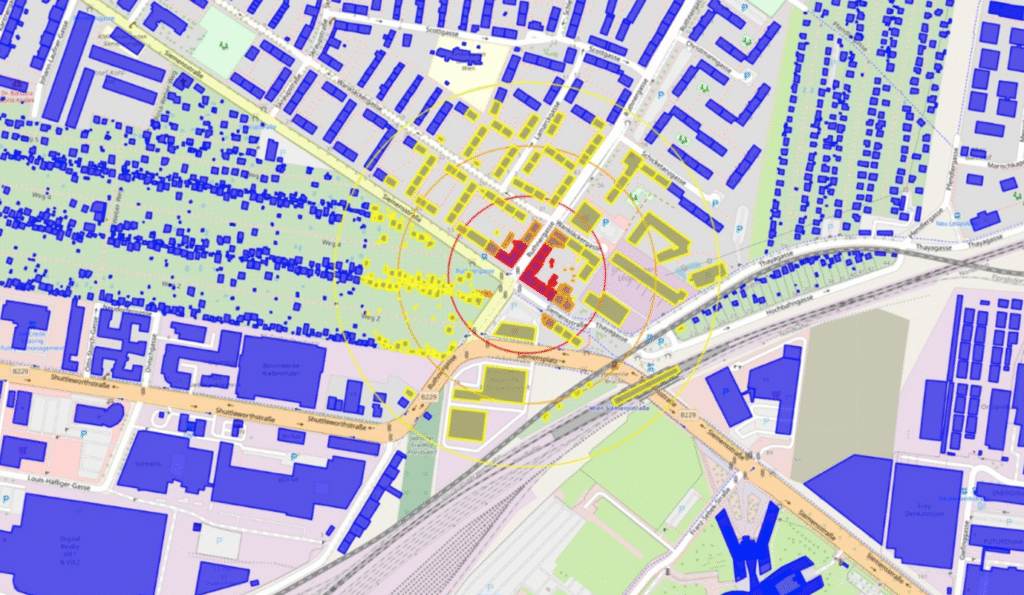
Use-Case 2 Cyber-Physical Attack
This was the final pilot scenario of the piloting phase of PANTHEON and thus simultaneously showcased the highest number of components developed throughout the project. For the training scenario, a man-made disaster in the form of a cyber-physical attack has been chosen through evaluation of probability against impact of such an event. The scenario type is a typical example for high-impact novel threats with little preparedness to date. Regarding the implementation of the scenario, a regular staff-exercise, focusing on the tactical (silver) level in the command chain, was executed with small PANTHEON specific adjustments.
In this scenario, the backup power supply systems (UPS) present at communications towers in the city are manipulated into dramatically overheating and exploding by an unknown, potentially terroristic, actor.
The exercise tasks focused on the management of force deployment as typically trained in the course of platoon commander qualification curricula by the disaster relief forces. The trainer had a central role in this scenario and acted as the command center for the trainees.
- Situational overview information from the PANTHEON system waspresented to trainees as though it was gathered by drone flyovers.
- Incidents happening at sites not surveyed by drones were simulated inside the system and shown to the trainer but not displayed to the trainees unless they task a drone flyover.
- Further information in the form of instructions from the command center complement the scenario.
- Force deployment inside the PANTHEON system was done by the trainer as communicated by the trainees.
Scenario flow:
• T0: The initial “chaos phase” started with the first Johanniter elements being dispatched after multiple small-scale explosions and fires have been reported around the city. The cause of the explosions, damage and number of casualties is yet unknown. Drone swarms were dispatched to provide initial situational overview including infrastructure damage, smoke dispersion and detection of casualties in outdoor areas. All drone swarming and sensor behaviour was simulated by the platform and dispach was trained to be arranged by an actual drone squadron commander on site during the pilot.
• T1: Additional explosions caused further casualties and disruption of traffic. Trainees needed to adapt to the changed situation and communicate with other first responder organizations. This phase incorporated the shift towards a structured deployment and a coordinated pulling-back from hot zones while larger scale evacuation was initiated.
• T2: In this phase, continued explosions led to the classification of the incident as a tactical attack on Vienna’s infrastructure. Hence, participants needed to reevaluate the initial placement of forces and collection points as well as reconsidered force deployment and routing.
At the end all participants together with the whole consortium had a great time witnessing the results of three hard years of work.
Thanks to all whose contributions made this achievement possible!